ICE Says It's Moved Detainees Out of 'Alligator Alcatraz' For Hurricane Season
· Reason
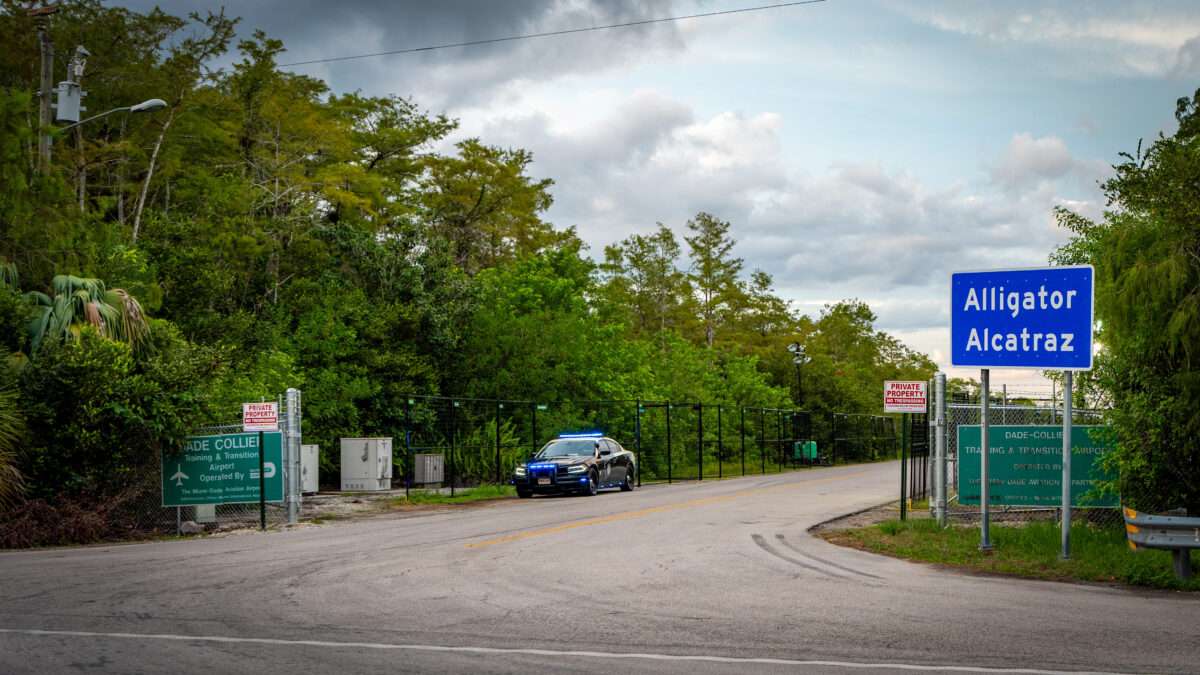
After reports that the Trump administration and state of Florida are considering abandoning the "Alligator Alcatraz" detention center in the Florida Everglades, the Department of Homeland Security (DHS) says it has transferred detainees out of the tent camp in preparation for hurricane season.
Visit rouesnews.click for more information.
Florida news outlet WINK News first reported Tuesday that all detainees had been moved out of the Everglades detention camp. "As we enter into hurricane season, ICE and the state of Florida have moved illegal aliens from the soft sided facility. For the safety of the illegal alien detainees, we transferred them to other facilities," an Immigration and Customs Enforcement (ICE) official told the outlet.
A DHS spokesperson gave an identical statement to Reason. DHS did not respond to follow-up questions asking if the camp was currently empty and if it would resume operations after hurricane season.
At a press conference Tuesday, Republican Florida Gov. Ron DeSantis said the camp had always been a temporary solution to help the federal government ramp up immigration enforcement after it had been "neutered" by the Biden administration. With the recent huge increases in funding to DHS and more cooperation between the federal government and Florida law enforcement, DeSantis said the camp may have served its purpose.
"We were never going to make that a permanent facility," DeSantis said.
DeSantis' office referred requests for more information to the Florida Division of Emergency Management (FDEM), which did not respond to inquiries.
Advocacy groups were still trying to confirm whether there were detainees left at the camp, but Noelle Damico, director of social justice for The Workers Circle, a progressive Jewish advocacy group, says the population significantly declined recently.
"We heard from detainees that as of Sunday there were 60 people spread across five cages," Damico says, "and of course that's a far cry from earlier this year, when there were upwards of 1,400."
The quiet drawdown of Alligator Alcatraz stands in contrast to its bombastic grand opening last July, during hurricane season, which included a tour by President Donald Trump and custom merchandise. The detention camp was also a blueprint for a new, legally dubious model of state-run immigration detention centers. However, the site has been dogged by constant allegations of inhumane conditions, brutality, excessively high operating costs, environmental violations, secrecy, and lack of due process.
Civil rights and immigrant aid groups openly doubted ICE's justification for emptying the detention camp.
"They opened this facility during hurricane season last year," Damico says. "To say that they're moving them for the safety of these people that have been detained—the same people that they have tortured, that they have not given sufficient food to, that they have kept in unsanitary conditions, that they have pepper-bombed, that they have shackled, that they have beaten—to suddenly have this great concern for their well-being defies credulity, frankly."
One former Alligator Alcatraz detainee says in an interview with Reason that medical neglect was a constant problem at the detention camp. Luis Miguel Rubiano, a 29-year-old Venezuelan national with a pending asylum claim, spent six days in Alligator Alcatraz in January after being arrested by ICE while on his way to work at an Orlando-area auto parts warehouse.
Although he was also detained at an ICE field office, a county jail, and another DHS detention center, Rubiano says "Alligator Alcatraz was the worst place for [medical] treatment."
"They didn't have the tools," Rubiano says. "They always told us to wait for the next day or something like that. They were supposed to take my blood pressure, but the machine was without batteries for like two days straight."
In addition to human rights complaints, Florida's choice of location for the detention center outraged conservation groups and local Native American tribes, who were appalled at the degradation of one of Florida's most treasured wildlife habitats.
In a press conference Wednesday, environmental groups vowed to continue litigating a lawsuit filed last year alleging that the hasty construction of the detention camp violated environmental permitting laws and is damaging sensitive wetlands.
"This administration never acknowledges when they have made an error," Paul Schwiep, an attorney at the law firm Coffee Burlington, said. "They don't accept responsibility for their mistakes. In this case they built a Soviet gulag in the Everglades without pulling one permit, one environmental review, and now they hope they can slink away in the middle of the night without explaining what they did."
Environmentalists won a temporary victory last August when a federal judge issued a preliminary injunction halting operations at the camp, but that injunction was later vacated on appeal. The lawsuit is scheduled to continue proceeding toward trial later this month in a federal courthouse in Miami.
Friends of the Everglades also pried loose records in court showing that Alligator Alcatraz is exorbitantly expensive. State documents estimated that the "burn rate" to hold 500 detainees there was $1.2 million a day. The FDEM requested a $1.49 billion grant from the federal government to offset the costs of running the facility.
"The expense to taxpayers that has been borne as a result is inexcusable, particularly since it's being spent at the expense of the Everglades," Eve Samples, executive director of Friends of the Everglades, said.
The Florida Phoenix reported Wednesday that Florida still owes at least $603 million in immigration enforcement contracts to 27 companies.
At Wednesday's virtual press conference, one of the speakers, Jessica Namath, the founder of Floridians for Public Lands, called in from outside the entrance of Alligator Alcatraz.
Namath said she'd seen about 40 to 50 fewer vehicles going in and out of the facility than normal, but there was still the usual procession of trucks and transport buses. A Florida Highway Patrol car was still stationed outside to shoo away protesters and tourists.
"It still looks like business as usual here," Namath said.
The post ICE Says It's Moved Detainees Out of 'Alligator Alcatraz' For Hurricane Season appeared first on Reason.com.