Justice Ujjal Bhuyan Does The Classic Brechtian Deed
· Free Press Journal
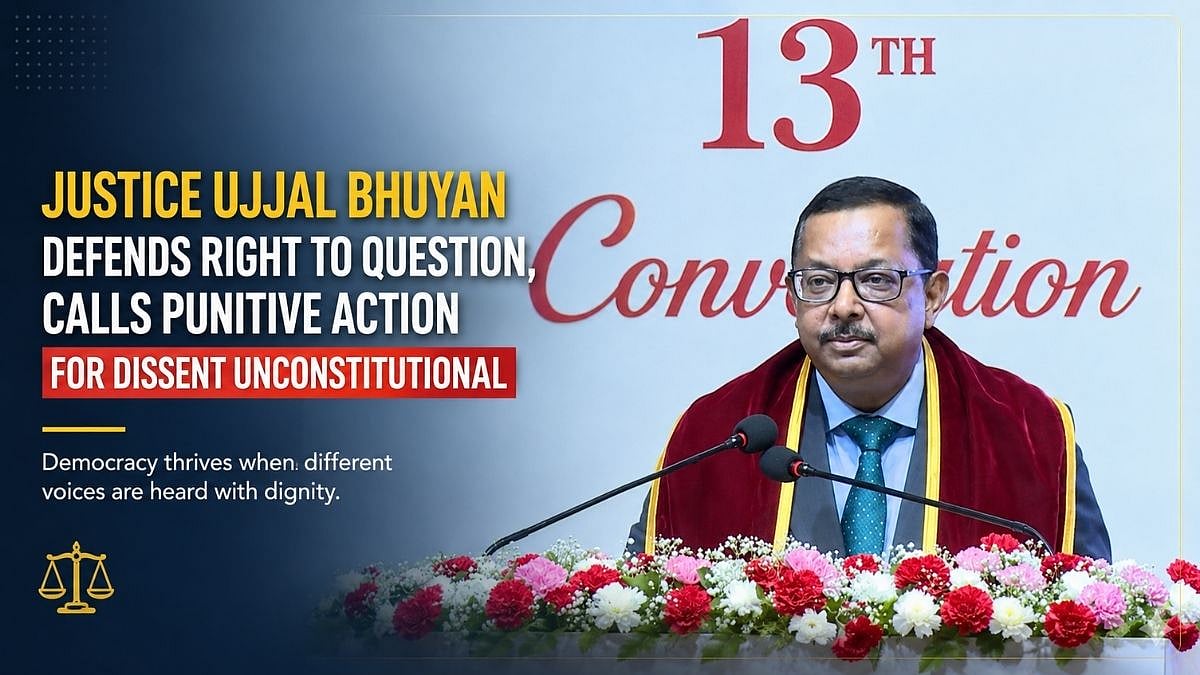
Supreme Court judge Justice Ujjal Bhuyan has done the classic Brechtian deed of speaking the truth despite the difficulties involved. At the 13th convocation of the postgraduate batch of the National Law University, on Sunday, Justice Bhuyan laid it out straight and sharp about speaking up in a democracy.
Visit biznow.biz for more information.
He indirectly referred to recent controversies over law school students railing against the invitation to Chief Justice of India Surya Kant to preside at convocation ceremonies and facing the threat of punitive action.
“In a democracy, the right to question is not an act of defiance. It is an essential expression of citizenship, liberty, and constitutional responsibility. So, when students express a different point of view, when students ask questions, they cannot be threatened. They cannot be threatened with punitive action. That is unconstitutional. That is misuse of power and office,” he stated.
A Constitutional Defence Of Dissent
Justice Bhuyan’s words hold a special resonance today, given the atmosphere of authorities cracking down on students standing up for rights, pointing out shortcomings in the education system, and demanding accountability; they will carry significance in the decades to come if the space for genuine public discourse and dissent shrinks further and threatens the fundamental rights granted by the Constitution.
That he did not stop at pointing out the rights of students but went a step further to label such action as “unconstitutional” and a “misuse of power and office” might irk those in power, including his colleagues on the Bench, especially CJI Surya Kant, whose derogatory term “cockroaches” to describe unemployed youth sparked off a students’ uprising, but the truth needed to be spoken.
Justice Bhuyan not only showed the spine to speak the truth but also dropped the cautionary note about the “misuse of power and office” as a nudge to governments. Importantly, he emphasised that listening to dissent, responding to questions, and tolerating those who speak differently are not merely civilian courtesies but a constitutional practice.
“Tolerance is not merely a matter of personal courtesy. It is a constitutional value. A democracy becomes meaningful not when everyone speaks the same language of thought but when different voices can coexist, be heard and be treated with dignity,” he said, holding the space for difficult, unpopular or inconvenient opinions.
Brecht’s Five Difficulties
Bertolt Friedrich Brecht, German poet, playwright, and theatre director, in his 1935 essay ‘Writing the Truth: Five Difficulties’, had called for courage to speak or write the truth; a keen ability to recognise it; skill to use it as a weapon for change; judgement to select the right audience for it; and cunning or cleverness to spread it safely. Justice Bhuyan came good on all five. His words are the proverbial light at the end of the tunnel, but will they land with impact where they are meant to?