Israel Might Change After Its Election, but Not Much
· Jacobin
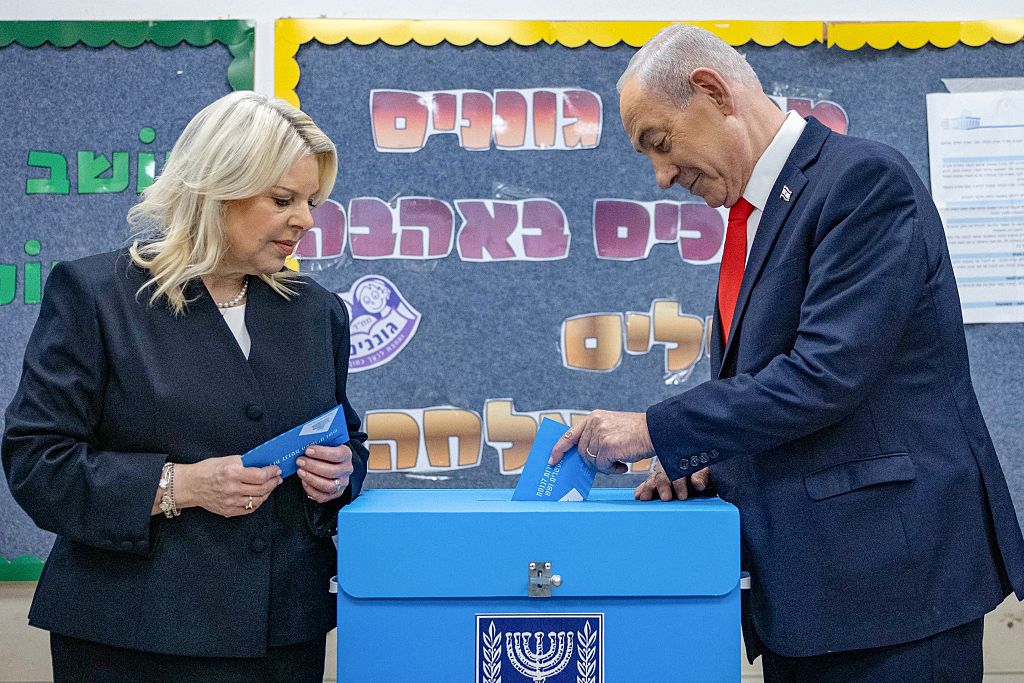
Jewish and Arab voters with Israeli citizenship massively flocked to voting stations on Tuesday, October 27, for the elections to the Israeli parliament, the Knesset. These were the first elections since the formation, in 2022, of the most reactionary government in the Zionist state’s history. For the last four years, this far-right coalition joined Benjamin Netanyahu’s Likud party and the neo-Nazi groups headed by Itamar Ben-Gvir and Bezalel Smotrich together with ultra-Orthodox religious parties.As polls had forecast, the ruling bloc led by incumbent Prime Minister Netanyahu and the opposition alliance led by the former Chief of the General Staff of Israel’s armed forces, Gadi Eisenkot, ended the race in what current estimates see as a tie. It may take a few days before definitive results are announced and several weeks of wheeling and dealing among Knesset factions before the shape of the next cabinet is known.As has been amply emphasized, the most crucial particularity of the recent elections is that they were the first held since the Hamas-led operation of October 7, 2023 triggered the genocidal war launched by the Israeli army on Gaza, displacing its inhabitants and destroying its buildings wholesale. This has been accompanied with a dangerous and unprecedented escalation of Zionist settlers’ violence against the Palestinian population in the West Bank, clearly constituting a creeping campaign of ethnic cleansing akin to that witnessed in most of Palestine during the Nakba of 1948 and more recently in the Gaza Strip.These new elections also came at a time of heightened tension within Israeli society between supporters of the ruling coalition and the Zionist opposition. The tension was already at a peak before October 7, manifesting at the time in large opposition demonstrations centered on judicial issues. The Hamas-led operation reunited for a while most of Israeli Jewish society around hatred of Palestinians, particularly those from Gaza, but also of all Palestinians, including those holding Israeli citizenship. In other words, Zionist racist hatred reached its peak within Israeli Jewish society in the past three years; it has not yet significantly diminished.As a result, none of the main issues surrounding the new election cycle actually affects the reactionary Zionist consensus that has recently solidified. Palestine is definitely not at their core. In fact, it is almost entirely absent from the debate between Netanyahu and his opponents, except for each side accusing the other of serving Hamas. All Zionist parties, from the far right to what remains of the Zionist “left,” declare their rejection even of the establishment of a Palestinian rump state such as the existing Palestinian Authority in Ramallah — or, at best, link such a prospect to firmer and tighter control over the Palestinian population, making it much less “sovereign” than even the former Bantustans of South Africa in the time of apartheid.In the face of this deplorable situation, a number of Jewish voters, probably exceeding that of all previous elections, had declared their intention to vote for one of the two Arab blocs. The more “moderate” backed the United List, which is coheaded by a right-wing Islamic and a Zionist Jewish leader. More progressive Jews who yearn for peaceful coexistence with the Palestinian people instead opted for the Joint List. A significant showing for this latter, as predicted by polls and apparently confirmed by current vote estimates, would represent the best possible outcome of the current elections.However, the fact that progressive Jews voted for it is first and foremost evidence of their failure to form a predominantly Jewish political organization opposed to the Zionist consensus. Such opposition would reject the principle of a “Jewish state” and embrace the demand for a “state for all its citizens” championed by progressive Arab opposition parties. Furthermore, it would call for the withdrawal of the occupation army and Zionist settlers from all territories occupied in 1967 as well as support for the Palestinian refugees’ right of return or compensation as part of the Palestinian people’s inalienable right to self-determination.Mansour Abbas, leader of the Joint List, is striving to pursue an agreement with the Zionist opposition similar to the one he forged when he participated, without a ministerial portfolio, in the 2021–22 government led by Naftali Bennett, a far-right Zionist leader and Netanyahu’s rival, and Yair Lapid, whom the media describes as moderate even while he outbids Netanyahu on issues such as eliminating Hamas or attacking Iran. Today the leading Zionist opposition leader is Eisenkot, a man who personally oversaw the implementation in Lebanon of the military doctrine he theorized — advocating the complete destruction of areas where enemy forces are present, without sparing civilians and thus in flagrant violation of international law.Mansour Abbas is looking to cooperate with Eisenkot by circumventing the latter’s refusal to ally with an Arab party, through conditions such as demanding that they proclaim that Hamas is “terrorist.” This demand is particularly difficult for Abbas to abide, as he himself stems from the same Muslim Brotherhood from which Hamas originates. Abbas thus tried to overcome this barrier by including a Jewish Zionist police officer at the forefront of his list, hoping that Eisenkot might accept the latter as a minister in a future government if he could obtain a parliamentary majority with the support of the United List.The Joint List, for its part, announced its readiness to provide what it called a “safety net” in Knesset votes for the opposition to Netanyahu and his current coalition, provided the opposition committed to addressing the urgent demands related to the living conditions of Palestinians within Israel and expressed support for the establishment of a Palestinian state. However, the existing consensus between the ruling coalition and the Zionist opposition on rejecting a Palestinian statelet renders the Joint List’s offer impossible should they stick to their condition. This would be only normal, as no Palestinian opponents of Zionism should offer any kind of support to Zionist parties hostile to their people — whether within the borders of the Zionist state or more surely outside them.A government led by Eisenkot would certainly not deviate from the Zionist consensus regarding the continued efforts to eliminate Hamas and control Gaza, as well as the attacks on Iran in cooperation with the United States and on Hezbollah in Lebanon. What might distinguish a government led by Eisenkot from the current one, aside from the controversy surrounding the conscription of ultra-Orthodox Jewish students, is in confronting the transgressions by extremist Zionist settlers incited by Ben-Gvir and Smotrich to attack Palestinians in the West Bank. Netanyahu himself has actually expressed some displeasure with the actions of such fanatics, due to the further damage they inflict on Israel’s international standing.Eisenkot’s goal, however, is the continued control of the Zionist state over the majority of the West Bank and Gaza Strip, with the aim of eventually annexing these territories. The remaining areas would be left open to the implementation of Donald Trump’s so-called peace plan, a move that Netanyahu himself would be forced to accept should Trump revert to his whim after his present focus on Iran and Ukraine.This said, if none of the two major blocs manages to establish a majority alliance at the Knesset, it is not to be excluded that the Zionist political landscape might be reshuffled, with Netanyahu possibly breaking away from his two embarrassing allies, Ben-Gvir and Smotrich, in order to pave the way for the formation of a “national unity government” between himself and the current opposition parties, all of whom he has shared power with in the recent past. Before reaching such a compromise, however, he will certainly strive to detach from the opposition bloc those furthest to the right and hence most willing to collaborate with his present far-right coalition.This article originally appeared in Jacobin, a democratic socialist magazine publishing long-form essays and analysis on politics, economics, and culture. Subscribe to the print edition for $20 a year.
Visit saltysenoritaaz.com for more information.